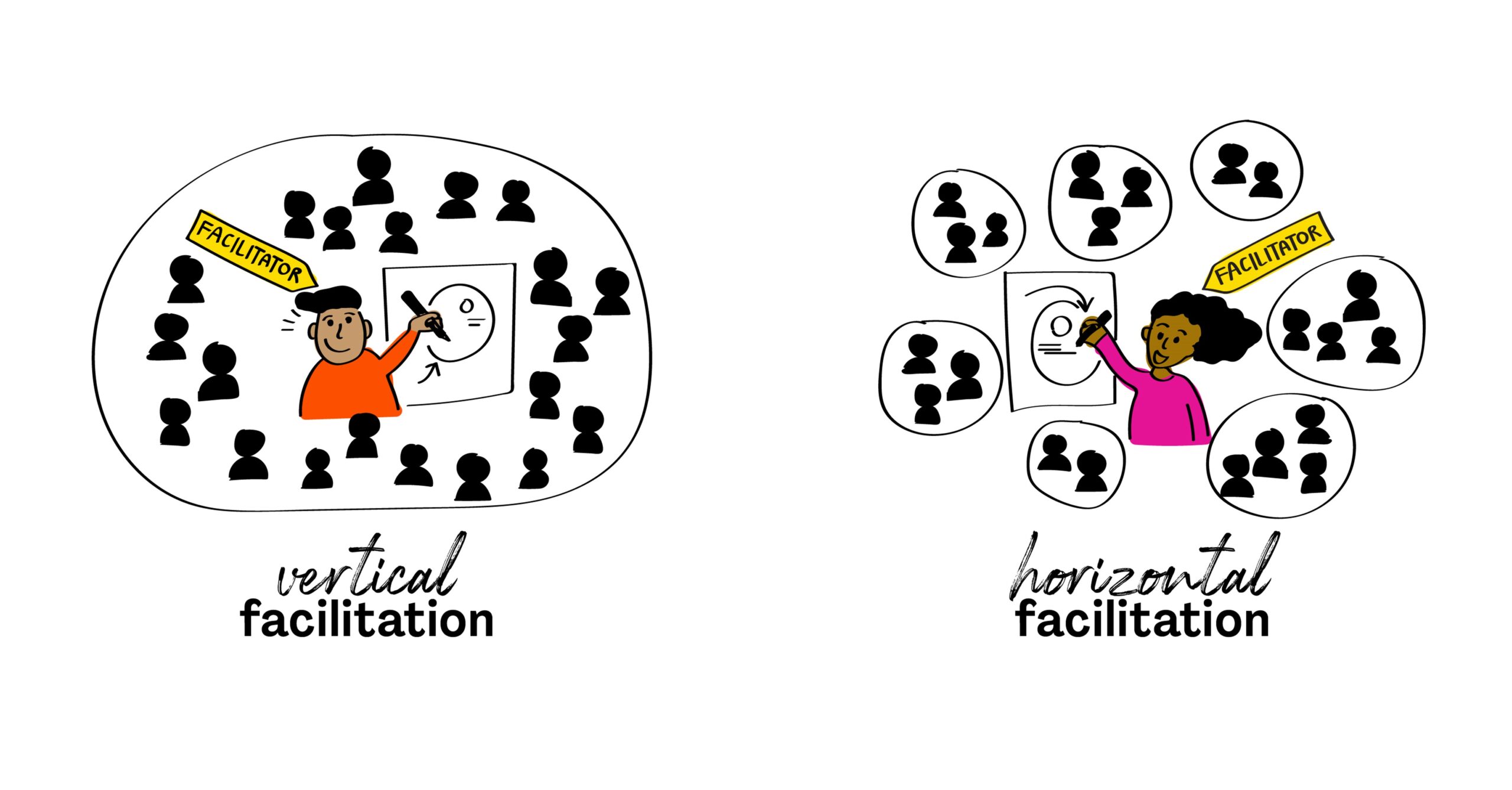
Dear Facilitators,
Welcome to the third (and last) facilitation newsletter of 2022!
In the previous newsletter back in April 2022, you got the chance to clarify your role as a facilitator and the power that comes with it. Could this power be used for transformative purposes? Yes! Let’s find out how transformative facilitation can catalyse breakthroughs in your gatherings…
Let’s refresh our memory…
Do you recall the definition of facilitation offered by Adam Kahane, author of “Facilitating Breakthrough”, that we shared in the April newsletter? Kahane explains that the “word facilitate means ‘to make easier’, and facilitation enables a group to work together more easily and effectively.”
Refresher done ✔️
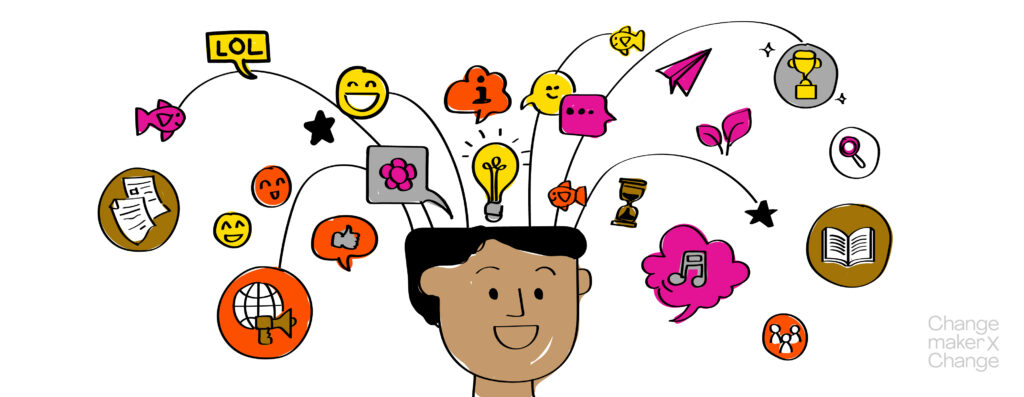
So, what about transformative facilitation?
According to Kahane, “transformative facilitation is a way of supporting people to create change through collaborating with diverse others, rather than through forcing things to be the way only some people want them to be”. This definition resonates with us at ChangemakerXchange because it suggests that the facilitator is there to support rather than force.
It also ties well with the concept of “generous authority” we explored in our practice call at the end of May 2022, whereby the facilitator uses “power to achieve outcomes that are generous, that are for others…” (Priya Parker). We discussed how the facilitator must find the courage to be authoritarian in the service of three goals: (1) protecting, (2) equalising, and (3) connecting your participants.
Now, back to transformative facilitation. This approach to facilitation works to remove “the obstacles to love, power, and justice” so that you may create a space that fosters “contribution, connection, and equity” and achieves change and collaboration. How can you do that, though?
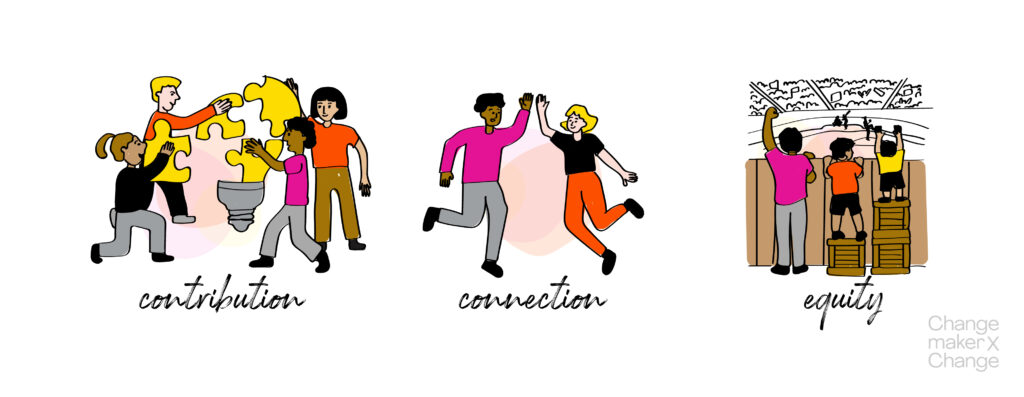
- Contribution: You can remove the obstacles to contribution by creating intentional opportunities for participants to share their diverse ideas, skills, and experiences to achieve the task at hand. Formats and methods like affinity mapping, case clinics, collective mind mapping, open space technology, and world café are just a few examples that invite participants to contribute.
- Connection: You can remove the obstacles to connection by making space in your gathering for participants to get to know each other as humans and to work together as peers. Formats and methods like check-ins and check-outs, buddy pairs/triads, changemaker river, and gratitude-based activities work well to foster connection.
- Equity: You can remove the obstacles to equity by fostering an egalitarian and respectful culture within the gathering. Formats and methods such as circle practice, collaborative decision making, social contracting, and participatory-based activities are very fitting here!
That sounds great, but how does it work in practice?
Now we get in into the juicy bits! Kahane explains that transformative facilitation is unconventional in the sense that it “incorporates and goes beyond the two conventional ways that are opposite and in tension”. What are they?
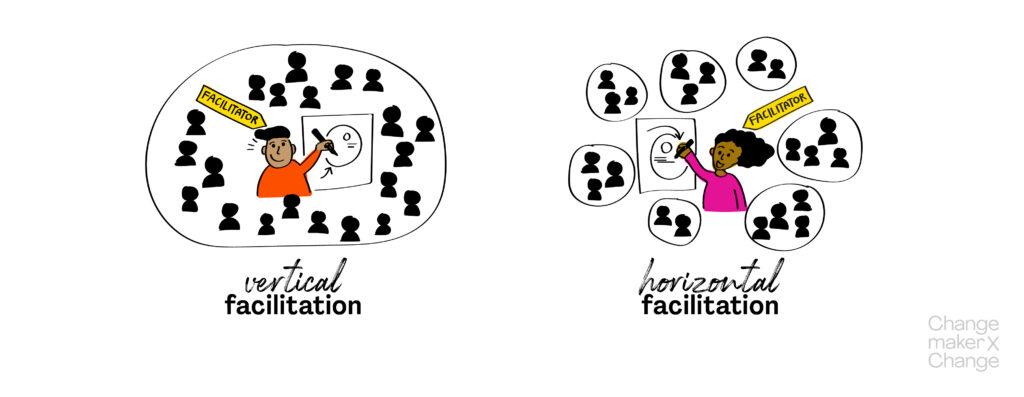
- Vertical facilitation: The “bossy” type of facilitation, whereby the facilitator directs from above to help the group as a whole achieve its objectives. The focus is on the “singular whole” of the collaboration: “the one united team, the one definition of the problem, the one best solution”, etc.
- Horizontal facilitation: The “collegial” type of facilitation, whereby the facilitator accompanies from alongside to help each member of the group achieve their own objectives. The focus here is on the “multiple parts” of the collaboration: “The positions and interests of the individual members of the group…, their different understandings of the problematic situation, multiple possible solutions and ways forward”, etc.
Both approaches have their objectives and strategies, as well as strengths and downsides.
Importantly, Kahane suggests that the two approaches are “more than just opposite poles: they are complementary”. And this is where facilitation can become transformative: when the facilitator chooses to employ both approaches, cycling between the vertical and the horizontal depending on what the group needs.
Sounds fascinating?
•••
If you would like to find out more, join our next practice call on Thursday, 10 November 2022 at 2:00–3:00 pm GMT+1. During this call, you will have the opportunity to discover more about the pros and cons of vertical and horizontal facilitation and understand how a transformative facilitator employs five vertical and five horizontal moves to help a group move forward together with greater coherence and flow.
The call will take place on Zoom (link here) – we will shortly send you a calendar invite which you can accept, tentatively accept, or decline. This will help us get a sense of how many participants to expect. Please note this call is open to anyone who attended one of our online ToT summits. This means that you will also have the chance to meet and exchange with other facilitators from our extended community of practice.