
Dear Facilitators,
We’d like to welcome 2023 with our fifth facilitation newsletter!
Transition times, like the start of a new year, or academic calendar, or new job, offer unique opportunities to start afresh. These times are usually accompanied by a new sense of possibility, which translates into energy for change. Have you already set aside some time to plan your 2023? Does facilitation feature in your intentions and goals for 2023?
For this newsletter, the focus is on you (rather than the beneficiaries of your facilitation, though the concepts explored might be useful to them too). This is our gift to wish you a successful year of facilitation!
The interior agenda of the facilitator
Wait, are we suggesting that the facilitator has a ‘hidden’ agenda? Not so much a ‘hidden’ agenda as an ‘interior’ one. We somewhat explored this implicitly in the previous two newsletters when we discussed the role (and power) of the facilitator as well as the discipline of transformative facilitation, but let’s make it explicit: you must continually engage in the inner work necessary to sustain the ways of being that enable you to do the outer work of the facilitator.
But as you know, making the change is one thing; embodying it is another.
We are creatures of habit

Yes, change is challenging. Even when you are looking forward to the change, it’s not that easy to embody it. How many times have you set New Year’s resolutions that faded away after a few weeks? Perhaps you can’t answer that question because you stopped trying to set resolutions that you know won’t stick. Why is that? Quite simply: because we are creatures of habit and there is comfort in habits.
What are habits? Habits are structures we have developed over time (by repeating certain behaviours time and time again until they become automatic) to get us through our days. Habits can be quite helpful in the sense that they reduce the cognitive load and free up mental capacity so you can focus your attention on something else.
Your brain doesn’t need to analyse every single aspect of a situation; it can rely on previous experiences to skip this mental process and take a decision quicker. James Clear, author of “Atomic Habits”, defines habits as “mental shortcuts learned from experience”.
However, like most things in life, habits are a double-edged sword. Good habits can build you up, but bad habits can cut you down. James Clear explains that understanding the details is crucial because your “outcomes are a lagging measure of your habits”. Also, Clear claims that you should forget about goals and focus on systems, whereby goals are the results you want to achieve and systems the processes that lead to those results.
Forget about goals, focus on systems
Clear identifies four problems with setting goals:
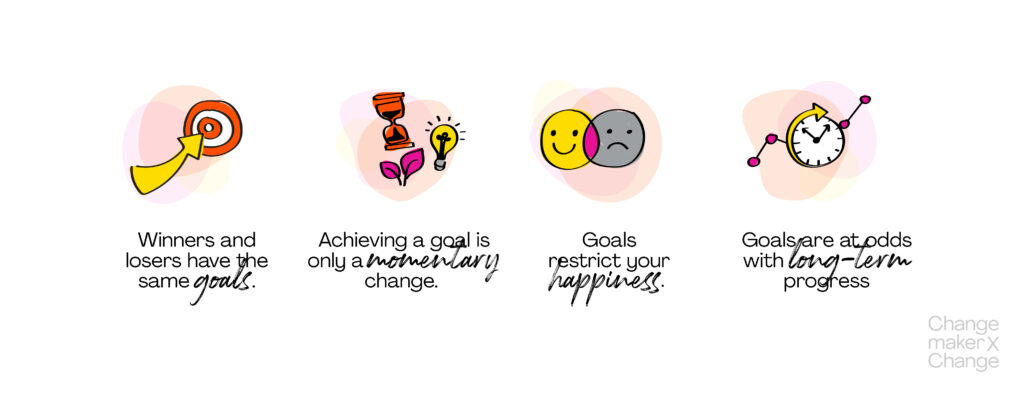
- Winners and losers have the same goals. This may sound obvious, but every Olympian wants to win a gold medal. Meaning that it’s not the “goal” that determines your success, but the system you follow.
- Achieving a goal is only a momentary change. Instead, you need to change the systems that cause certain results because if you fix the inputs, the outputs will fix themselves.
- Goals restrict your happiness. The risk is that you put off happiness until the next milestone and if you achieve your goal, you’re successful; if not, you’re a failure. A systems-first mentality focuses on the process rather than the result.
- Goals are at odds with long-term progress. Setting goals help you “win the game” but how will you sustain your effort once the goal has been achieved? Focusing on systems enables you to continue playing the game.
Okay, but how do you actually change habits? First, you need to change the “right” thing and second, you need to change your habits in the “right” way.
3 layers of behaviour change
Clear warns that we often try to change the wrong thing. Consider the three levels at which change can occur:
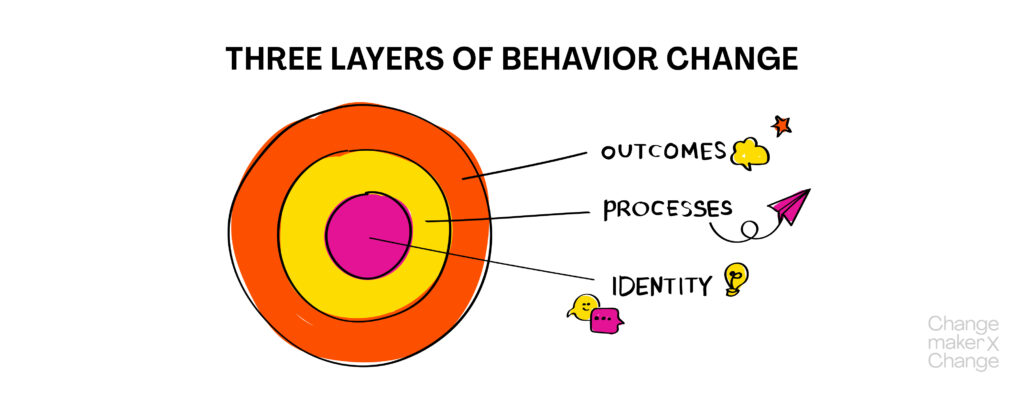
- Outcomes. This level is about changing your results, e.g. securing a facilitation contract.
- Process. This level is about changing your habits and systems, e.g. decluttering your desk for better workflow.
- Identity. This level is about changing your beliefs, e.g. your image of yourself as a facilitator.
Now, many people start by focusing on what they want to achieve, which leads them to outcome-based habits. The alternative that James Clear recommends is focusing on who you wish to become to build identity-based habits. This is because behaviours that are incongruent with your identity will not last long.

4 steps of habit-building
Once you clarify what is the right thing to change, Clear suggests there are four steps to build habits:
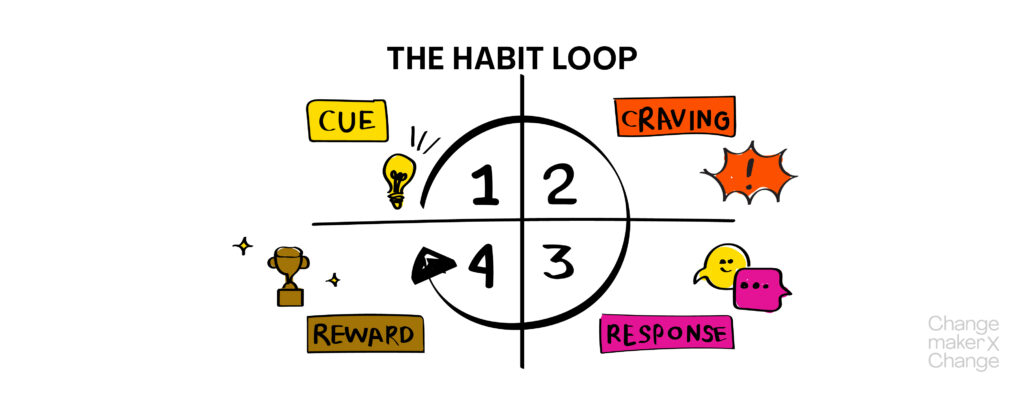
- Cue. The cue triggers your brain to initiate a behaviour.
- Craving. The craving acts as the motivational force behind every habit.
- Response. The response is the actual habit you perform, e.g. a thought or an action.
- Reward. The reward is the end goal of the habit, which both satisfies your craving and teaches you what is worth remembering in the future.
Should a behaviour lack in any of the four stages, it will not become a habit.
•••
If you are interested in learning how to transform these four steps into a practical framework that you can use to build good habits and eliminate bad ones, [Name], join our next practice call on Tuesday, 14 February 2023 at 3:00–4:00 pm GMT+1. The call will take place on Zoom (link here) and you will shortly receive a calendar invite. Please either accept, tentatively accept, or decline the invite so we know how many of you will be there.
NOTE: To prepare for this call, we invite you to reflect on the following question: Who do I want to become as a facilitator? Reflect on what you stand for, what your principles and values are, etc. If this feels too big, you can start from “concrete” results (facilitation-wise) and move backward to unpack your facilitation identity: Who is the type of person who could get those results?