
Dear Facilitators,
Do you remember that the previous newsletter (sent in January 2023) focused on the topic of habits because we acknowledged that there is comfort in them? After all, our human brain likes to plan and predict as a way to feel in control. This tendency may show up in your facilitation too: think about the time you spend designing a session because you are intentional about every step of the process. However, your amazingly creative human brain often forgets to plan for and predict the only certainty that exists: the unexpected.
Welcome to the sixth CXC facilitation newsletter, exploring the immense potential of channelling the ‘hidden force in the world’: serendipity.

What is serendipity (and what it is not)?
Dr Christian Busch, author of “The Serendipity Mindset: The Art and Science of Creating Good Luck”, explains that serendipity is different from blind luck. In fact, it is about ‘unexpected good luck resulting from unplanned moments in which proactive decisions lead to positive outcomes’. Let’s break this down into the three characteristics of serendipity, as described by Dr Busch.
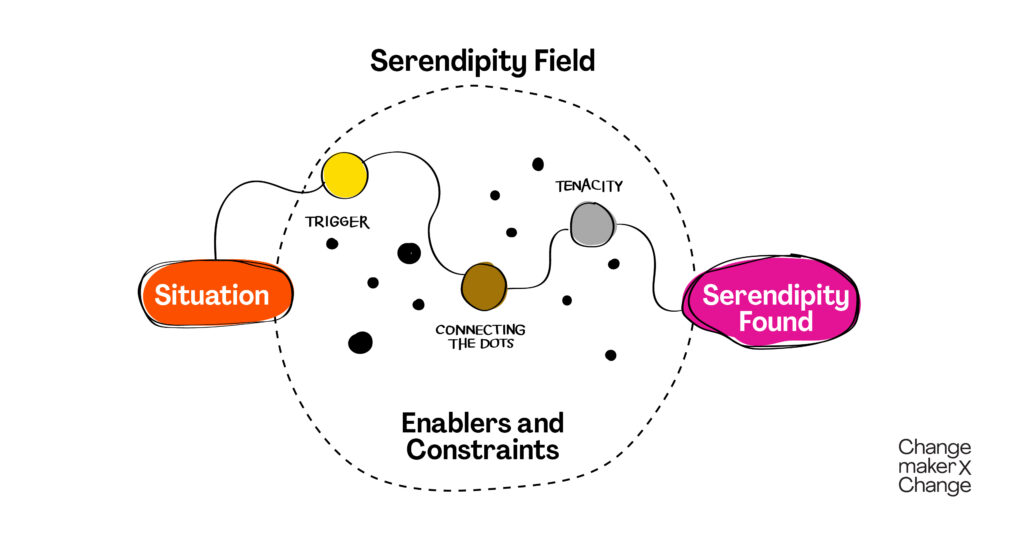
- Serendipity does involve the encounter with an unexpected situation. This is referred to as the serendipity trigger.
- What differentiates serendipity from blind luck is that instead of being a passive recipient of the unexpected situation, you link the trigger to something previously unrelated. This is where you connect the dots and realise the potential value of the unexpected situation.
- Importantly, the value created is not what you expected. It is unanticipated.
In a nutshell, ‘serendipity is about the ability to recognize and leverage the value in unexpected encounters and information’. Isn’t this a fitting description for what you often aim to do when you are facilitating groups? If only it were that easy…
What gets in the way of cultivating serendipity?
According to Dr Busch, your preconceptions of the world (aka your unconscious biases) are the biggest barriers to serendipity. There are four basic biases:
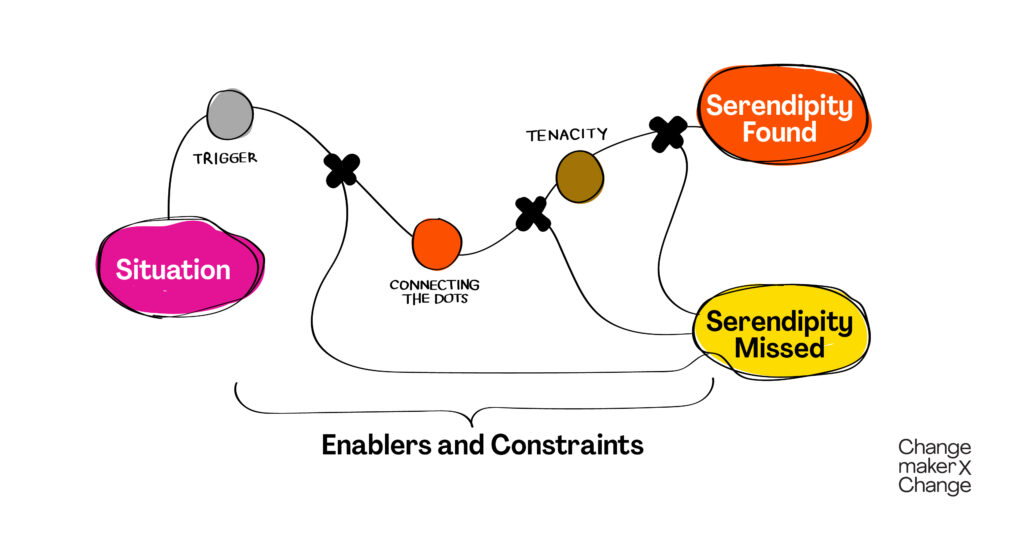
- Underestimating the unexpected. As shared at the beginning of the newsletter, your brain tends to underestimate how likely the unexpected happens. The truth is: the unexpected happens all the time!
- Conforming to the majority. How often do you end up self-censoring yourself to go with the majority? From an evolutionary perspective, it made sense: going against the majority might result in being ostracised from the tribe, making survival a lot more difficult. However, today, herd mentality can kill serendipity.
- Post-rationalisation. In hindsight, it (almost) all makes sense, doesn’t it? You are a meaning-making creature, so you look at past events and find the red thread, connecting certain details whilst ignoring others. Again, from an evolutionary perspective, this is very helpful: you are quicker at recognising patterns and making decisions, which gives you an edge. However, this linear storytelling often comes at the expense of what happened in reality.
- Functional fixedness. Your knowledge and expertise can be both a blessing and a curse. They are a blessing because they help you spot connections where others see gaps. But they become a curse if you become rigid and stop using them in novel ways.
The good news is that whilst serendipity cannot be controlled or predicted, you can cultivate a serendipity mindset.
How, you might wonder? Keep reading…
•••
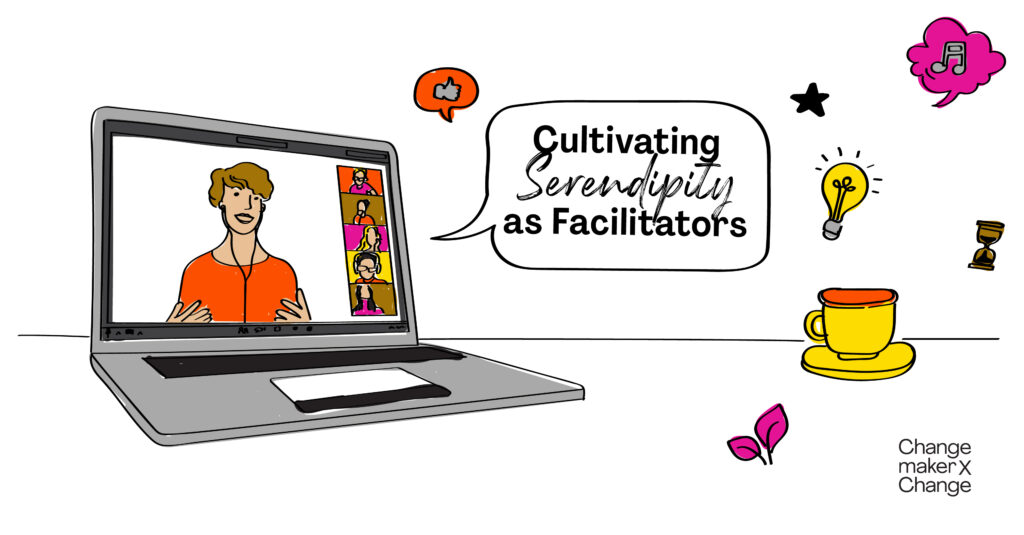
We are thrilled to announce that the author of the book, Dr Christian Busch, will join our next practice call on Thursday, 18 May 2023 at 3:00–4:00 pm GMT+2. Building on his research at NYU and LSE as well as his work as community builder and entrepreneur (e.g., Leaders on Purpose, Sandbox Network), Christian will help you deepen your understanding of serendipity and explore ways to cultivate it in your facilitation. The call will take place on Zoom (link here) and you will shortly receive a calendar invite. Please either accept, tentatively accept, or decline the invite so we know how many of you will be there.
NOTE: To prepare for this call, we invite you to pause for a moment and reflect on the instances of serendipity in your life. What helped make them happen? What can we all learn from them? What strategies help you cultivate serendipity in your facilitation?