Dear Facilitators,
Welcome to the seventh CXC facilitation newsletter (the last one in 2023)!
Do you recall our January 2023 newsletter, which explored the importance of engaging in the inner work necessary to sustain the ways of being that enable you to do the outer work of the facilitator? The intention was to offer a space for you to learn about yourself, in practice.
Well, learning is the focus of this upcoming newsletter, though we turn outwards to explore ways to support transformative learning among your participants. It is a useful add-on to the October 2022 newsletter on “transformative facilitation” too!

Different learning domains
While many understandings of learning exist in the world, it might be useful to consider Habermas’ (1970) three domains of learning (simplified and adapted from Transformative Coaching: A learning theory for practice by Susan Askew and Eileen Carnell):
- Domain 1: You help participants acquire new skills and competencies to learn to act in their environment.
- Domain 2: You help participants see something differently to learn for personal meaning and understanding through social interaction.
- Domain 3: You help participants learn more about the self in practice (reflective learning) which leads to perspective transformation.
One common element across the three domains is that learning involves change (and facilitation is a great tool to encourage and support change!).
However, “while all learning involves change, not all change involves transformation” (Mezirow, 1991). Here we focus on the kinds of learning that involve transformation.
Let’s take a closer look.
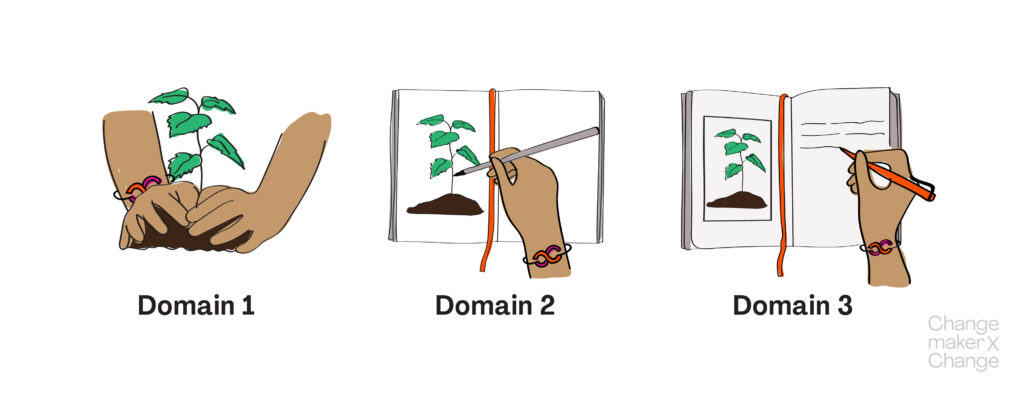
Domain 1: Learning to act in the environment
This domain is concerned with “learning to take action that leads to us getting the results that we, or others, require”. Therefore, the focus is on behaviour change so that you may predict the variables that affect the consequences of your actions and decide on the best course of action. This domain is more externally focused and goal oriented.
Domain 2: Learning for personal meaning and understanding
This domain is more interested in meaning-making, acknowledging that “[k]nowledge… is created in a cultural context through relating and communicating with others and is subjective…”. Hence the effort is geared towards understanding meaning, not observation.
Domain 3: Reflective learning leading to perspective transformation
This domain goes deeper and invites learning about yourself through reflection on the self, in practice. “Its purpose is for perspective transformation, that is, a change to the way we perceive our contexts and ourselves.” Within Habermas’ third domain, Mezirow (1981) distinguishes between two levels:
- Level 1: Consciousness • You become aware of specific perception, meaning or behaviour.
- Level 2: Critical Consciousness • You evaluate your value judgements, “leading to a process of ‘emancipation’ from old, unhelpful ways of seeing the world and behaving, to more open, discriminating and including meaning schemes.
On the importance of consciousness, Carl Jung said: “Without consciousness there would, practically speaking, be no world, for the world exists as such only in so far as it is consciously reflected and considered by a psyche. Consciousness is a precondition of being.”
What tools are available to support reflective learning?
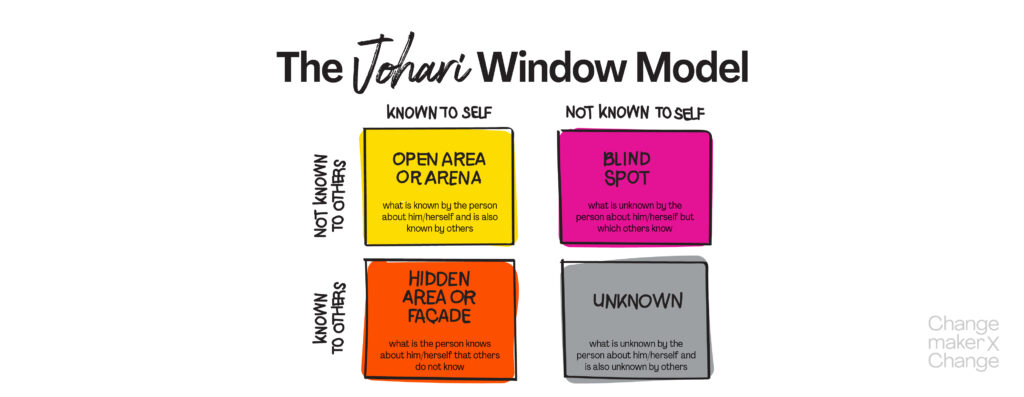
Johari’s window, devised by Joseph Luft and Harry Ingham, is a popular tool to increase knowledge about the self. Each quadrant contains the information that is known / unknow by the person as well as known / unknown by others.
•••
If you are curious to dig a little deeper into the potential of facilitating for reflective learning, we invite you to join our next practice call on Thursday, 19 October 2023 at 3:00–4:00 pm GMT+2. You will be guided through a process to understand seven levels of consciousness and how you might adapt your facilitation to support change.
The call will take place on Zoom (link here) and you will shortly receive a calendar invite. Please either accept, tentatively accept, or decline the invite so we know how many of you will be there.