
Dear Facilitators,
Welcome to the ninth CXC facilitation newsletter!
Perhaps it is because ‘spring is in the air’ where this newsletter was written or because we wish to balance the seriousness of the January newsletter. Whatever it may be, this newsletter is going to be a light-hearted and playful one. Some of you might be rolling their eyes up already: “It is hard enough to make people understand that facilitation is a legit profession and that you are not there as the class clown. Now you want to talk about play?”
Play at the core of creativity and innovation

Children are the prime example of how play stimulates creativity and innovation. But this you know already. Surely, that is different in adults, right? Not quite. In the book The Gifts of Imperfection, author Brené Brown quotes Dr Stuart Brown under precept #7 (cultivating play and rest).
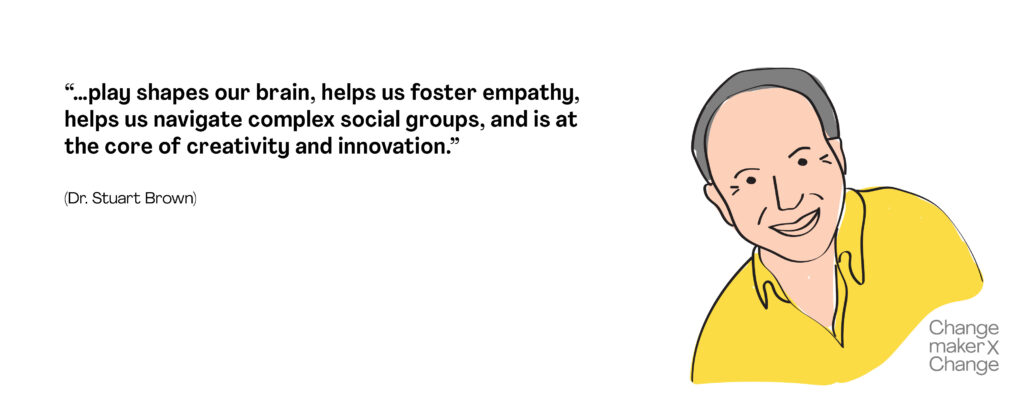
Doesn’t this seem quite fitting to facilitation? But what exactly is play? Dr Brown sheds away from defining play too strictly because any definition would defeat its purpose but highlights 7 properties of play.
- Purposelessness. Apparently, play has no practical value (e.g., it may not necessarily earn you money or material advantages).
- Voluntary nature. There is no obligation. Otherwise, the activity loses its play component.
- Inherent attraction. Behavioural science explains that play brings about psychological arousal. It feels good.
- Freedom from time. Play allows you to escape from the constrains of the world. You lose track of time.
- Diminished self-consciousness. It also allows you to break free from ‘needing to look good or smart’ and tap into what Mihaly Csikszentmihalyi called flow.
- Improvisational potential. Play makes space for serendipity, opening the door to new possibilities.
- Continuation of desire. The pleasure you derive from play drives the desire to continue it.
How can you cultivate play in your facilitation?
Just type “play in facilitation” in your search engine and you might come across resources such as The LEGO Foundation’s Learning Through Play or the LinkedIn Facilitation Advice on incorporating play into your facilitation training. What about you? How do you cultivate play in your facilitation? Here are some of the activities and formats we use at CXC.
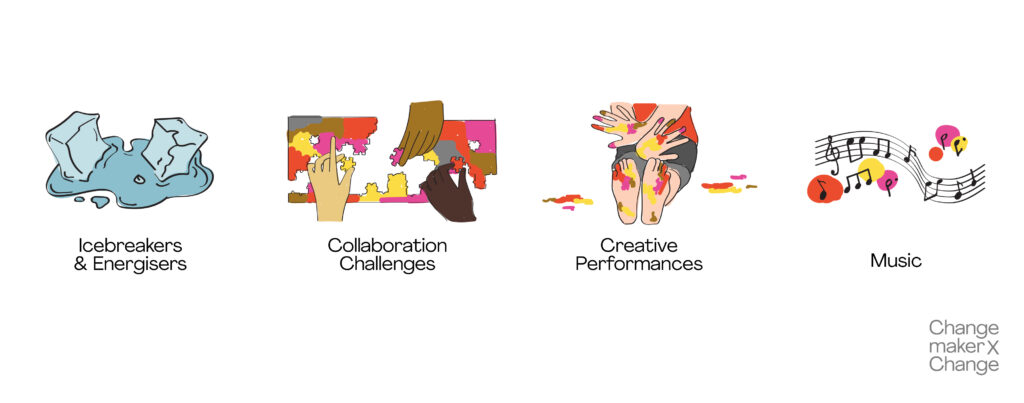
- Icebreakers and energisers. There are thousands of them so we will not even attempt to list them, but icebreakers and energisers are great mini opportunities to sprinkle some fun and play here and there.
- Collaboration challenges. Again, these vary from very quick activities (more like energisers) to more complex activities. These offer insightful learning opportunities for your participants.
- Creative performances. From performances to harvest takeaways to co-created talent shows at the end of your event, tapping into the world of ‘performances’ is incredibly effective to cultivate fun and play.
- Music. We could write an entire newsletter on the importance of music in facilitation (we might well do so in the future!), but music is your ally when you wish to stimulate a particular mood or energy in your group.
These are just a few examples, but there is one more we would like to introduce…
Easter eggs
Wikipedia informs us that “an easter egg is a message, image, or feature hidden in software, a video game, a film, or another–usually electronic–medium.” It derives from the egg hunt (a form of treasure hunt) played at Easter in certain countries where children look for hidden decorated eggs (or Easter eggs) in their garden. Well, we have hijacked the term to adapt it to the facilitation context.
In facilitation, easter eggs are small details or attentions that make participants feel cared for and therefore make their experience more enjoyable. Here is where you can get very creative and playful! A few ideas…
- Learn your participants’ names before they arrive. Print out pictures with the names (and any other relevant details) of your participants and practise. You can turn this into a “participants’ bingo challenge” with your co-facilitators.
- Handwrite a welcome message. Write a personalised welcome message to your participants and stick it to door of their bedroom (or place it inside).
- Let them pick a wisdom nugget. Prepare slips of papers with inspiring quotes that participants can pick at the start of the event and accompany them throughout.
- Take a high-res portrait picture of each participant. Getting a high-quality headshot is expensive. If you have booked a photographer for your event, organise a photoshoot session and share the headshots after the event.
Curious to discover more…?
•••
Join our next practice call on Thursday, 23 May 2024 at 2:00–3:00pm GMT+2 to discover more facilitation Easter eggs and… share your own! Yes, you heard us right: we invite you to come prepared and share your favourite Easter eggs so we can increase our collective knowledge!
The call will take place on Zoom (link here) and you will shortly receive a calendar invite. Please either accept, tentatively accept, or decline the invite so we know how many of you will be there.