
Dear Facilitators,
Welcome to the 10th CXC Facilitation Newsletter, which features a guest piece by me (Esther here, a CXC Facilitator) while Greta is on maternity leave!
The future is hot right now (literally and figuratively). It’s in our advertising. It’s on social media. It’s in political messaging. It’s everywhere. What better moment to take out our imaginary future-scopes and gaze at the distant horizon?
Today’s newsletter is going to explore a methodology called Futures Thinking which I have found to be a powerful tool to navigate conversations about the future with real people, today. You’ll learn that the future is emotional, it’s a practice and, surprise, there are actually many of them (que the Spiderman pluriverse meme.)

Extending our Horizon
Extending our view of the horizon out 10, 20, 50, 100 years is not new to culture and decision-making – strategies such as Collective Imagination, Seventh Generation Thinking, World Building, and Afrofuturism have all played fundamental roles in communities envisioning alternative futures and moving towards positive ones. Today, I’d like to draw your attention to a strategy coined in the early 1970s called Futures Thinking.
This evolving method provides just enough scaffolding to be practical about the future and just enough flexibility to be creative, allowing us to expand what we think is possible. Whether at the micro or meta levels, Futures Thinking presents a diverse number of pathways to convert our realities into alternative future scenarios and narratives that can inform decisions, design, and planning by blending research, design, facilitation, and storytelling.
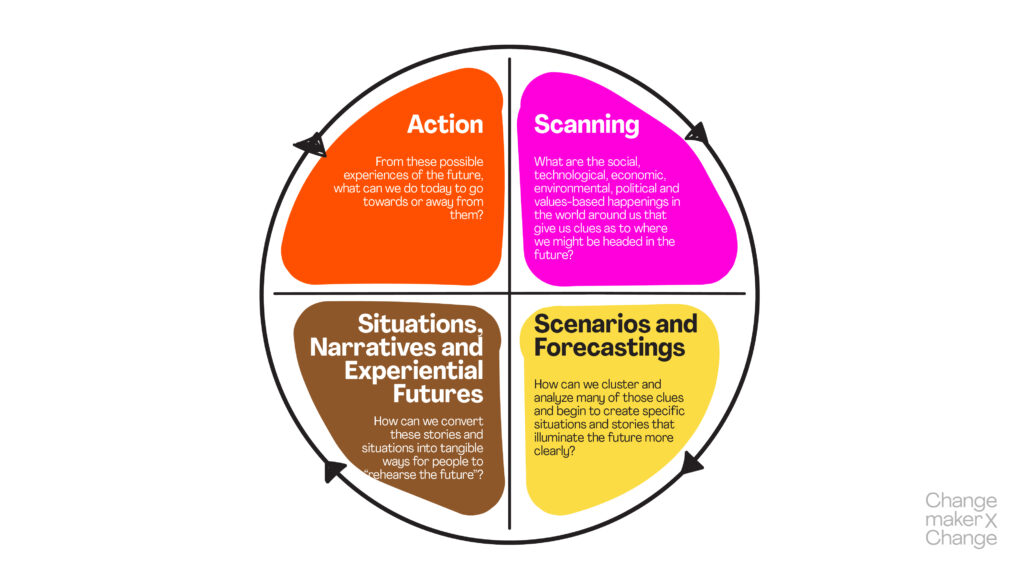
There are three key ways that facilitators can add to the human-factor of Futures Thinking – navigating emotions, guiding practice, and acknowledging the many different visions of the future.
The Future is….
Emotional
Futuring with others requires us to acknowledge the many emotions it brings up. Grief, fear, anxiety, and sadness but also hope, creativity, and curiosity.
Here are two examples of how you can apply this in practice:
- Give time at various intervals, especially the beginning, to surface feelings in the group. Expect that these emotions may create some volatility within the conversations.
- Design intentional outlets for strong emotions like humour, movement, or simple breaks.
A Practice
Exploring different paths towards the future and the many levers that have to be pulled in order for a different future to arrive, cannot be done in a workshop. I know, I know. This is a facilitation newsletter. If it can’t be done in a workshop, then why are we even here?!
Chances are, if you are thinking about the future and seeking out spaces to facilitate conversations with it, you are only going to get that one workshop. Therefore, the responsibility that we take up as facilitators, is ensuring that those who are engaging in that conversation are encouraged to consider this as a muscle that needs to be continually exercised and that this is just one of the many workout sessions participants can indulge in.
Here are two ways in which you can remind participants that it is a practice:
- Frame sessions using the language of practice over process. Yes, there may be a process you are guiding people through, with an outcome that is semi-tangible, but that process can be repeated over-and-over again.
- Consider ways to help participants stretch their imaginations, quickly. I personally love to use some of the card decks (physical and digital) that are out there including Design Fictions from Near Futures Laboratory and The Thing from the Future from Situation Lab.
Plural
It is common when we speak about the future that there will be pressure to devise a singular global and positive future that all people are in support of and all beings benefit from. There is absolutely an important role for the profound experience of deep interconnectedness and oneness of all beings that this singular, global and positive future can have in motivating individuals and communities towards change.
However, when futuring work has a direct, tangible impact on the lives of, or engages the voices of, individuals and communities today, it is useful to narrow down to what Elisabet Roselló refers to as a “tangle of local future visions”.
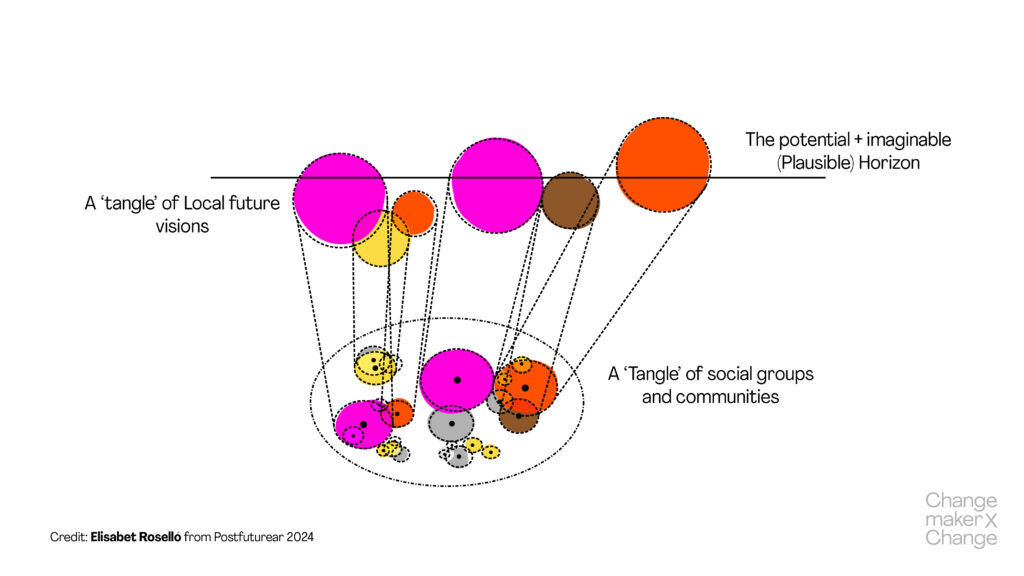
Here are two pointers for surfacing that “tangle of local future visions”:
- Shift your mindset and let go of the pressure of moving many billions of people towards a common goal in a single workshop. Consider the PEMS model here and how as facilitators we can navigate groups between the Spiritual and the Practical conversations about the future.
- Looking at a single “thing” can be a practical starting point for a conversation about the future. If groups are able to look, discuss and project into the future something familiar such as a water bottle, or a bus route they will have an easier time considering the ecosystem of places, services, and systems around it. This is often referred to as the “Future Mundane”. You can take a look at this interesting short-film that shows how simple objects can tell a clear story of the future.
Your skills as facilitators can support individuals, companies and communities to grapple with some of these BIG questions of tomorrow:
What do many visions for the future look like for those who will be experiencing them? How can you talk about and surface those local visions together? Which global visions of the future are most highlighted and which local visions are being ignored, can you facilitate spaces where both are acknowledged? How might a “tangle of local visions” be fundamentally intertwined with the design, decisions and actions that are made to bring about specific future pathways?
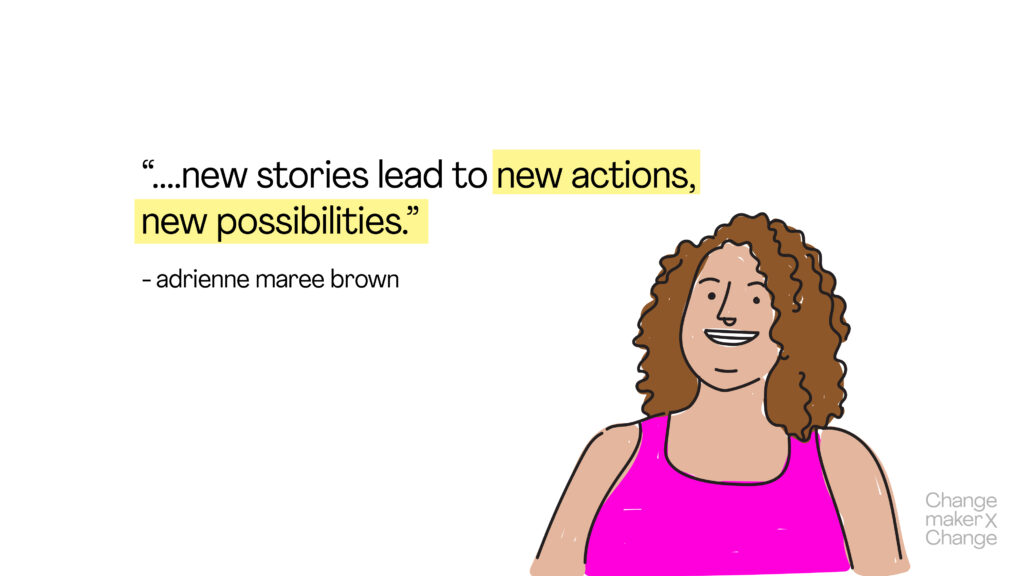
As facilitators, you have the gift – and responsibility – of crafting spaces that can allow new stories of the future to emerge.
This is only the tip of the iceberg. Curious to discover more…?
Join our next practice call on Thursday, 24 October 2024 at 3:00–4:00pm GMT+2 to exercise your futuring muscles! The call will take place on Zoom (link here) and you will shortly receive a calendar invite. Please either accept, tentatively accept, or decline the invite so we know how many of you will be there.