By Greta Rossi
Dear Facilitators,
Welcome to the first newsletter from The Facilitators in 2026! This year, we are freshening up our approach so you will benefit from:
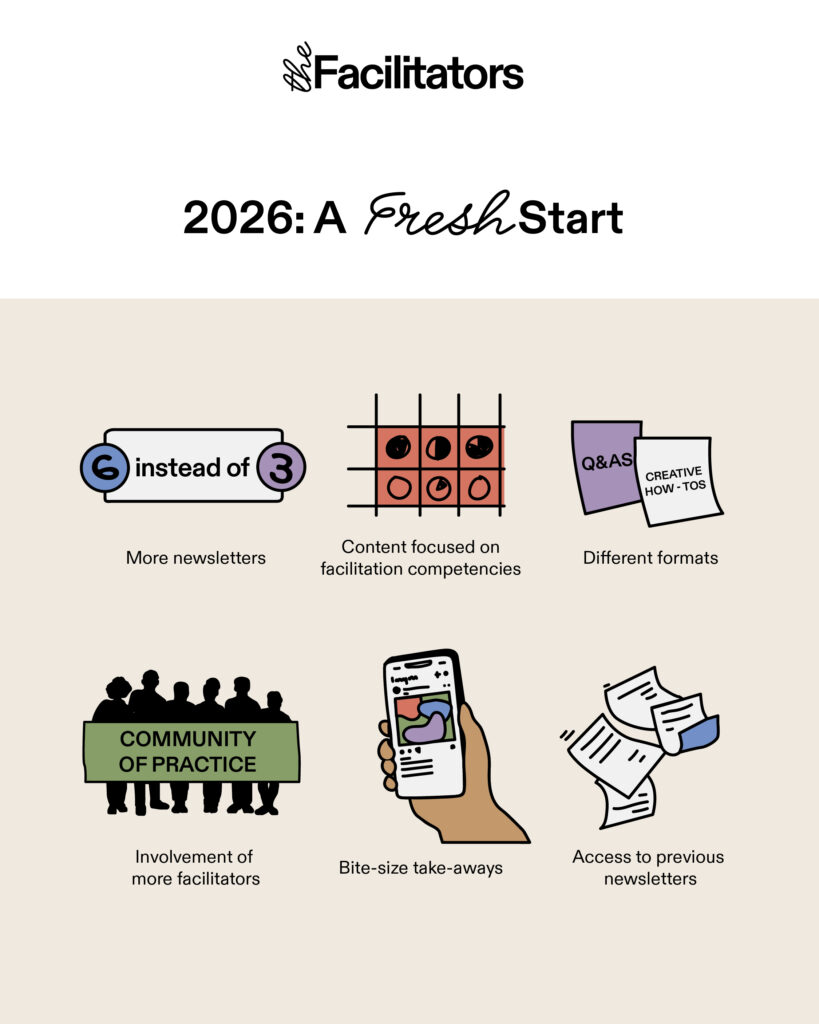
Also, we’re opening our newsletter to those outside our Facilitation Network, so feel free to share this with anyone who might find it relevant and invite them to subscribe at thefacilitators.org.
The skill of multiperspectivity
Okay, time to reveal the topic of our first three newsletters… multiperspectivity.
The first piece focuses on introducing the skill in depth, in particular its relevance to facilitation. The second piece will contextualise multiperspectivity thanks to the wisdom of diverse experiences. And the third piece will share creative ways to apply it in your facilitation.
Definitions & Origins
Yes, we know – it is not an easy word to pronounce. Try to break it down: mul•ti•per•spec•tiv•i•ty.
You might know it by other terms, such as polyperspectivity or multiplicity of view points or multi view or multi angle, etc. At its core, multiperspectivity is “the ability to expand your understanding to integrate multiple points of view”.
This term is usually applied to the study of narrative and storytelling where the audience is presented with more than one perspective.
However, as scholar Marcus Hartner (Lecturer of English Literature, Bielefeld University) explains, “[for] the notion to make sense pragmatically, its usage has to be restricted to cases where points of view interact in salient and significant ways and thus create multiperspecitivity by, for instance, repeatedly portraying the same event from various different angles”.
Additionally, multiperspectivity has been adopted in recent decades by historians, scholars, and educators to “question the validity of singular (one-sided) historical narratives” (Multiperspectivity: What Is It, and Why Use It?). It is used as a tool to question truth and power and increase diversity and cultural pluralism because all too often the voices of many groups have been silenced or ignored in traditional historical narratives.
Relevance to facilitation
Why does multiperspectivity matter in facilitation, both from the point of view of facilitators and participants?
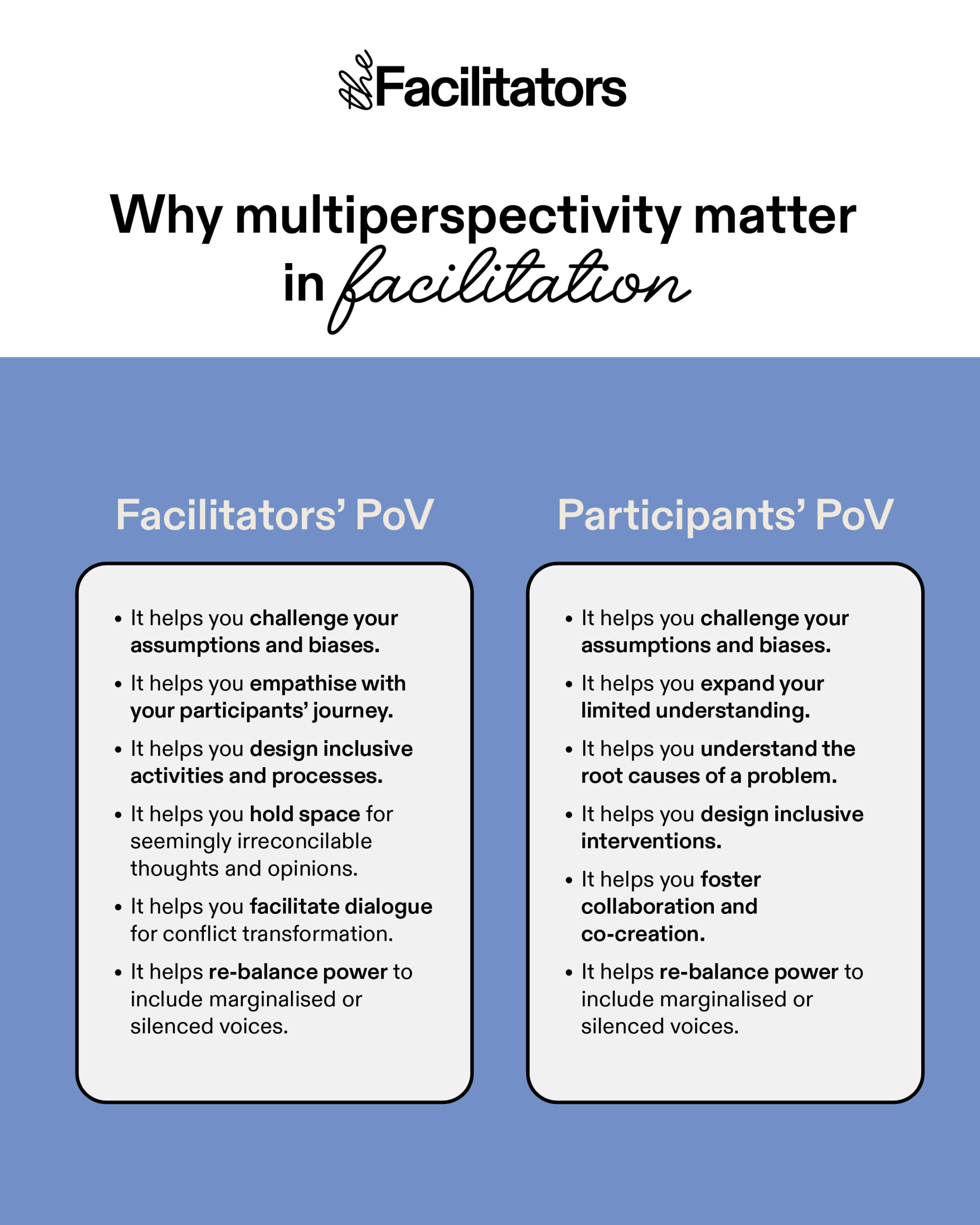
This skill is essential to help you and your participants understand and navigate a world of increasing complexity.
As Joana Breidenbach (Cultural Anthropologist, Author, and Social Entrepreneur) and Bettina Rollow (Executive Coach and Organisational Developer) write in “New Work Needs Inner Work”, “[in] the multi-perspective, one partly steps out of one’s own experiences in order to take on the perspective of the other even more comprehensively”.
Critically, as Recipes for Wellbeing points out, “[m]ultiperspectivity extends beyond intellectual understanding – in fact, it is a practice of empathy, curiosity, and humility.”
Open versus closed multiperspectivity
Back to the study of narrative and storytelling to dig deeper into some of the nuances of multiperspectivity.
In “The Theory and Analysis of Drama”, Manfred Pfister (Professor of English, University of Passau) differentiates between “open” and “closed” forms of multiperspectivity (each with their pros and cons).
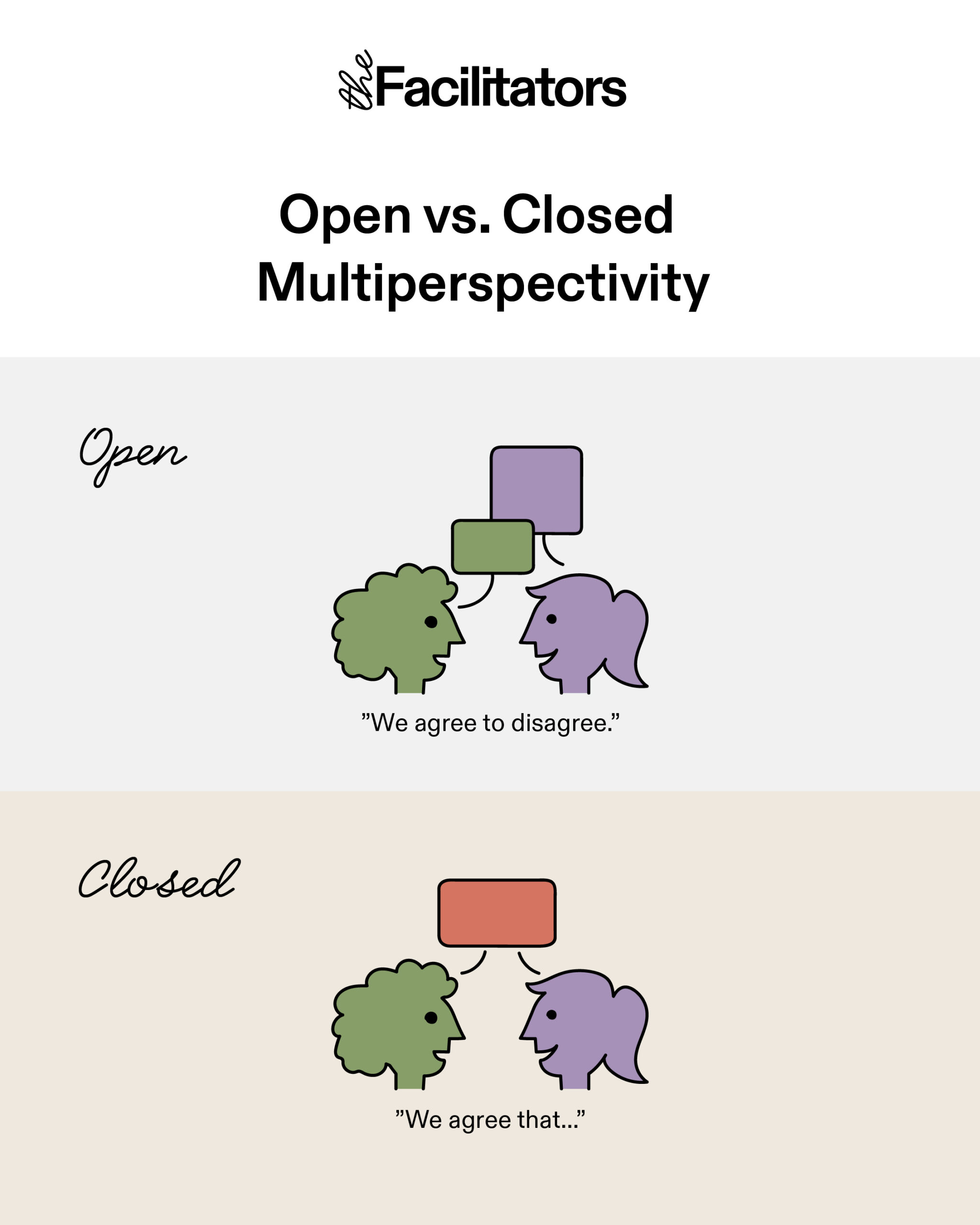
- Open: Participants are presented or engage with dissonant views that are allowed to co-exist and interact without converging into a conclusive narrative (e.g. ending with “we agree to disagree”).
- Closed: Participants are presented or engage with different perspectives which can ultimately be integrated into a coherent narrative (e.g. ending with “we agree that…”).
Which form should you focus on as a facilitator? It’s a tough question to answer.
- On one side of the spectrum, you have facilitators who prioritise ‘harmony’ within a group and might therefore opt for ‘closed’ forms of multiperspectivity. These are well suited to point out the relative or limited nature of individual perspectives and suggest moving towards a unified (or dominant) narrative. This approach to multiperspectivity connects with Adam Kahane’s definition of vertical facilitation, which “focuses on the singular whole of the collaboration: the one united team, the one definition of the problem, the one best solution…”.
- On the other side of the spectrum, you have facilitators who prioritise ‘equality’ within a group and might therefore prefer ‘open’ forms of multiperspectivity. These focus on dissonant and conflicting perspectives to question singular narratives and do not attempt to reconcile the irreconcilable. This approach to multiperspectivity connects with Adam Kahane’s definition of horizontal facilitation, which “focuses on the multiple parts of the collaboration: the positions and interests of the individual members of the group…, their different understanding of the problematic situation, multiple possible solutions and ways forward…”.
Now, Kahane* goes on to suggest the two approaches are complementary and that facilitation can only be transformative when the facilitator employs both approaches.
*If you are curious to dig deeper into Adam Kahane’s transformative facilitation, check out our dedicated newsletter on the topic.
A precious gemstone
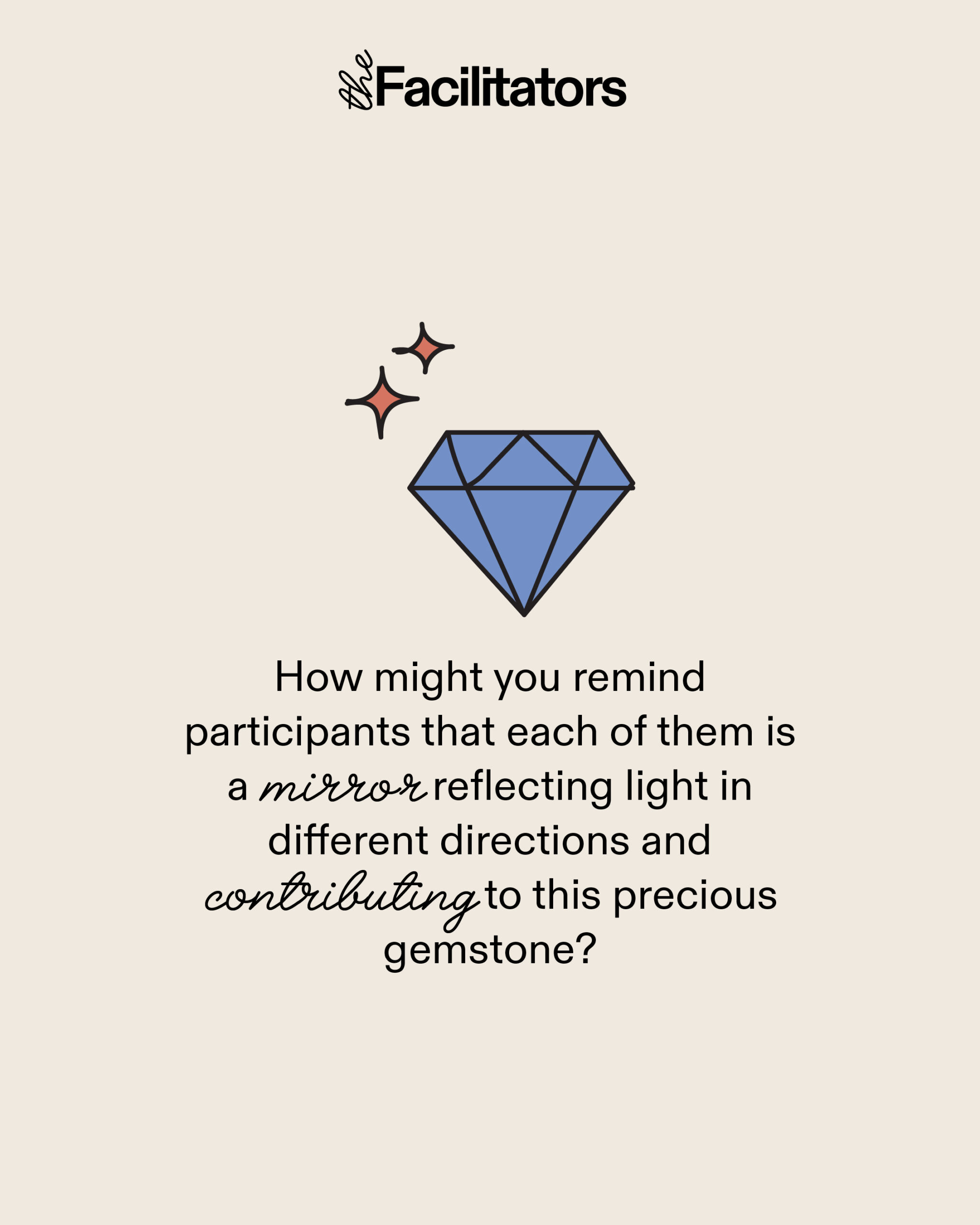
You can think of multiperspectivity as a diamond – yes, the precious gemstone. For a diamond to be a diamond, the carbon atoms must be arranged in a solid form and in a crystal structure. Its singularity and wholeness are intrinsically dependent on the unique arrangement of its many facets, which vary in shape, size, and placement. Each facet represents a tiny mirror into a unique perspective, reflecting light in a different direction. Together, all these perspectives create the mesmerising sparkle we all admire in diamonds.
Digging deeper
In the next newsletter, we will contextualise this skill to unearth additional nuances and practices. But in the meantime, here are some resources if you’d like to dig deeper:
- The skill of multiperspectivity, Recipes for Wellbeing
- The power of perspective, Dia Draper, TEDxCharlottesville
- The power of outrospection, Roman Krznaric, RSA Animate
Happy digging!
That’s all from us. In the next newsletter, we will dive deeper into the skill of multiperspectivity by learning from different practioners, so stay tuned!